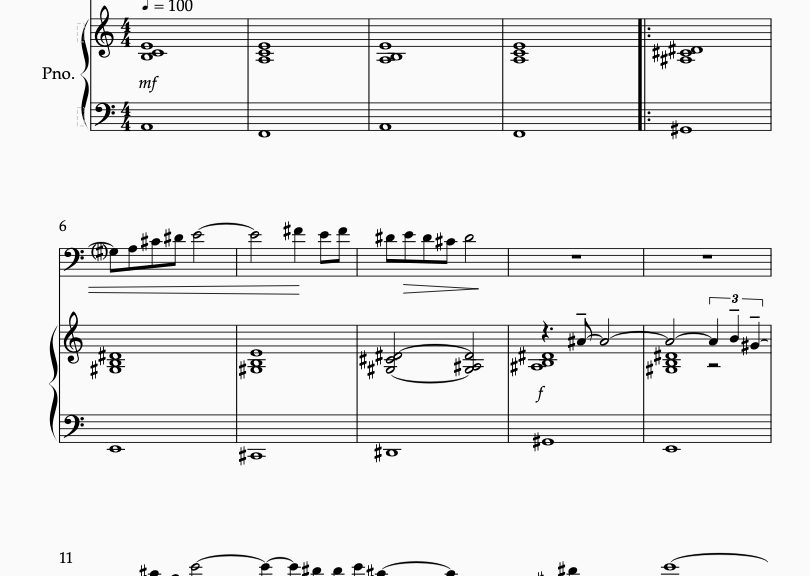
This arrangement I made for melodian and piano. I love the sound of the melodian, somewhere between bandoneon and harmonica.
As a professional pianist, I just discovered the melodian lately. It is big fun.
This arrangement I made for melodian and piano. I love the sound of the melodian, somewhere between bandoneon and harmonica.
As a professional pianist, I just discovered the melodian lately. It is big fun.
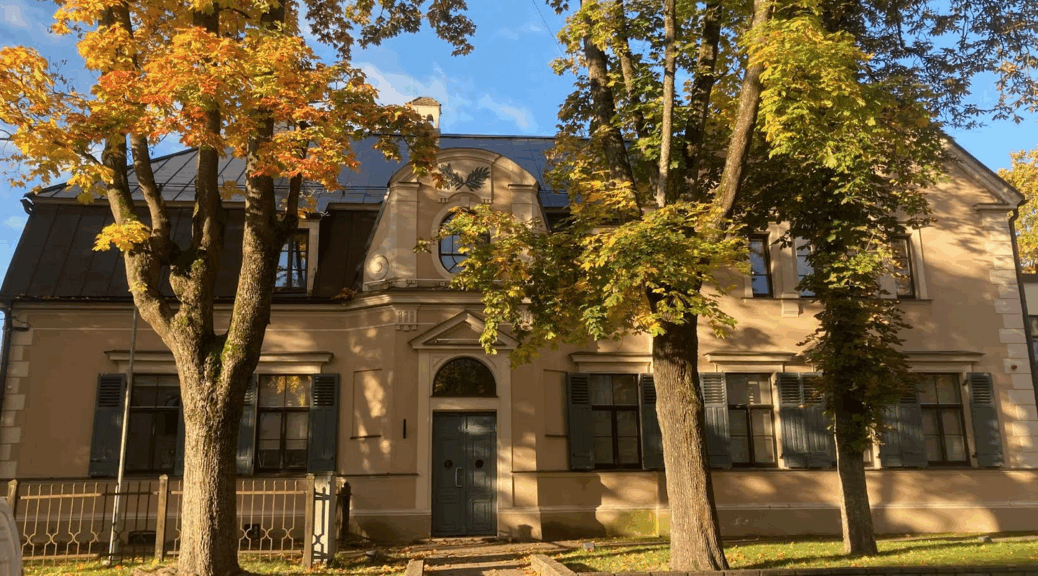
Very lucky to have been one of 45 teachers attending the 1st official European Suzuki Piano Days in Riga Latvia. Organizers Kristine Ravine, Michelle Post, Sylvain Pénard and Anna Sibley had magical powers and everything went very smooth, from the first morning with kids and teachers performing various parts of ‘Carnaval des animaux’ from C.Saint-Saëns in a both original and funny way!
I had the honour of playing the National Anthem of Latvia in my own arrangement with four Latvian teachers, and using my ‘Waves’ with seven other teachers during a group session.
45 teachers from 17 countries felt deeply connected to one another. I know I will keep in touch with many of them. New friendships were made, old friends hugged again, all senses were involved in learning, group piano playing, technique classes, reading, intense and fun discussions with exchanges of ideas.
You can hear fragments of them in the audio appendix (recorded with the simple dictating function of my Iphone)

The following books are view copies. Please don’t forward them without my permission.
Link to Webshop Donemus for Piano animals
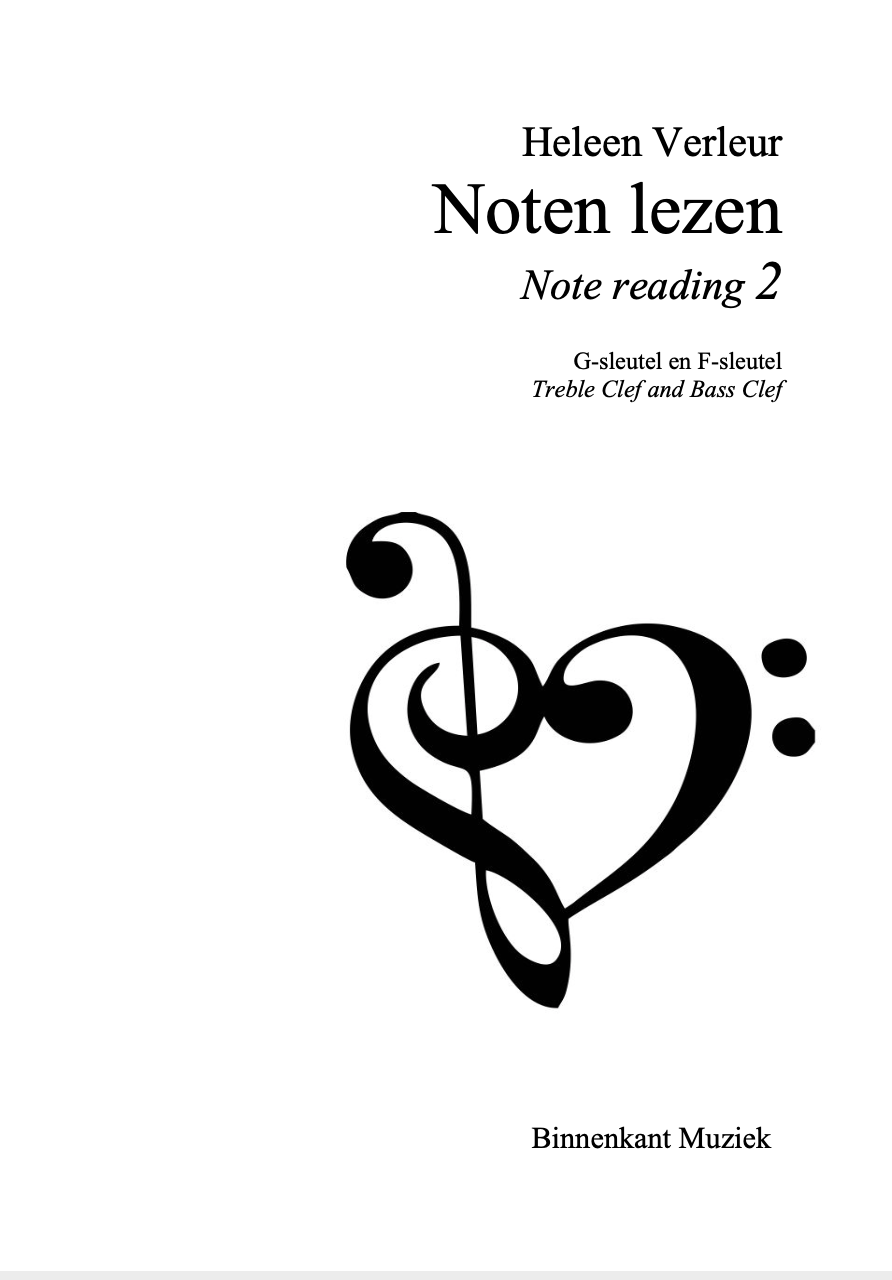
Inleiding
In boek 1 zaten voornamelijk noten tussen de lijnen (“even” noten).
Dit was om de tertsen goed te leren onderscheiden. Vanaf nu gaan we hierop voortbouwen. De tertsen worden “ingekleurd” met “oneven” lijn-noten.
In dit tweede boekje komen de noten door de lijn in de vorm van toonladdertjes aan bod. De even noten vormen hierbij het raamwerk, en geven steun bij het lezen van de oneven noten. Het is als bij een kleurplaat: de even noten zijn de afbeelding, het inkleuren wordt gedaan met de oneven noten. Het gaat om de snelle herkenning van de noten, het moet uiteindelijk volkomen geautomatiseerd zijn.
Bij de meeste oefeningen heb ik de stokken weggelaten, zodat de leerling zich helemaal kan focussen op de hoogte. Ritme wordt een ander boekje!
Aan het eind van het boek is nog een apart hoofdstuk over meer intervallen. Dit kan desgewenst ook eerder worden doorgenomen
Introduction
In book 1 there were mainly “even” notes (between the lines), to learn to recognize the interval third. The beginning pianist is invited to discover a larger range of the keyboard. One doesn’t always count from the middle C or one specific note. The result is a better orientation.
In this follow-up booklet 2 also the notes on the lines (“odd” notes) will be used in short pieces with scale patterns. The even notes form the
Framework making the reading of the odd notes easier. It’s like a colouring picture: first there is a drawing, then the drawing is colored with odd notes. It’s all about fast recognition of the notes, and the more automatically this goes, the better!
I have omitted the sticks for most exercises, so that the student can fully focus on the height. Rhythm becomes a new book!
In the appendix there is a separate chapter on more intervals. This can also be discussed earlier if desired.
Heleen Verleur, april 2024
He only started very recently. He is doing such a great job! And so do his parents, who are so involved.
Dit stuk was eerder oorspronkelijk voor baritonsax & piano geschreven (speciaal voor Arthur Heuwekemeijer!) maar ter gelegenheid van de boekpresentatie van Jan, heb ik het ook gearrangeerd voor fagot & piano.
Some time ago I arranged this Maple Leaf Rag I for five (right) hands on piano. It is big fun (and possible!) to play it on one piano, but if you have the luxury to use multiple pianos, this is also possible.
Tips for playing on one piano:
Other pieces I arranged for five hands on one piano:
Anitra’s Tanz/Grieg
Die Forelle/Schubert
William Tell/Rossini
Habanera/Bizet
Eine kleine Nachtmusik/Mozart
Train/Verleur: Intercity (movie)
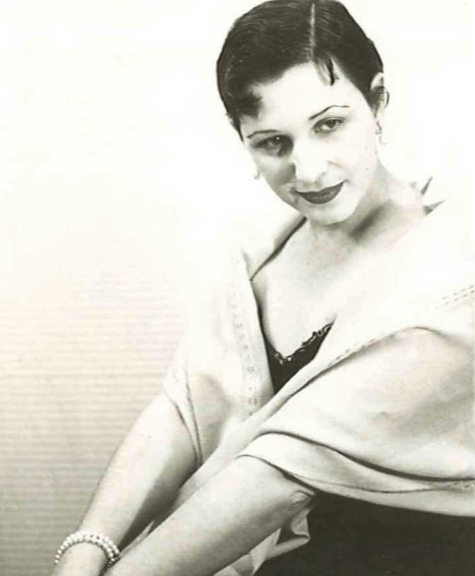
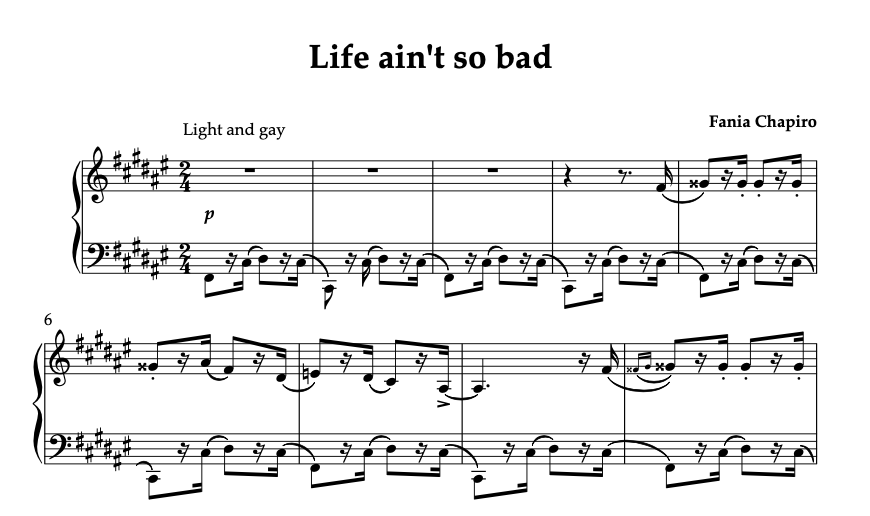
This cheerful Boogie was written by my former teacher Fania Chapiro in 1951. Deze vrolijke Boogie schreef mijn oud-lerares Fania Chapiro in 1951.
Meer over Fania Chapiro is hier te lezen.
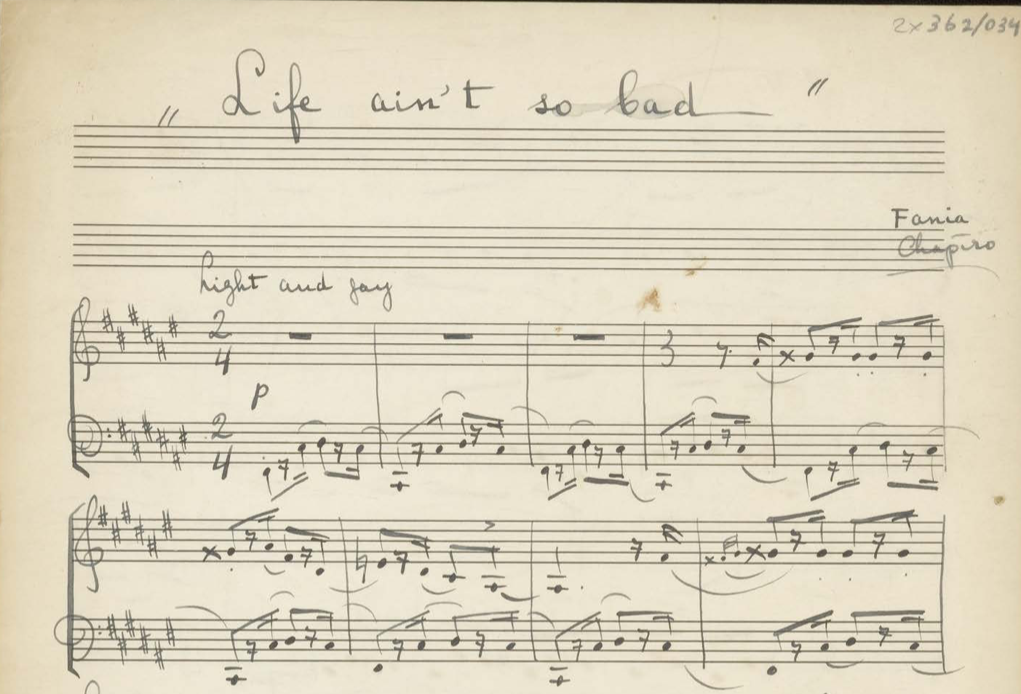
Chapiro’s handwritten version was converted into Sibelius notation by me for a concert. Frankly, I like her handwriting better, but the Sibelius version is a little easier to read, especially in the busier passages. This piece again reminded me very much of a CD recording with her in a little church in Kortenhoef, where I was allowed to turn her pages. Although there was almost only music of Mozart recorded, Fania had to relax in the break by indeed playing some Boogie-Woogie. She liked that and could do it well.
Chapiro’s handgeschreven versie van “Life ain’t so bad” | Donemus is voor een concert door mij omgezet in Sibelius notatie. Eerlijk gezegd vind ik haar handschrift mooier, maar de Sibelius versie is iets makkelijker te lezen, vooral in de drukkere passages. Ik moest bij dit stuk weer heel erg denken aan een cd-opname met haar in een kerkje in Kortenhoef, waar ik haar bladzijden mocht omslaan. Hoewel er bijna alleen muziek van Mozart werd opgenomen, moest Fania zich in de pauze even ontspannen door inderdaad wat Boogie-Woogie te spelen. Dat vond ze leuk en kon ze ook goed.
You can hear the mp3 of the piece below. It is a recording of a live performance on Sunday, January 21, 2024 in Huis van de Wijk Lydia (Roelof Hartplein, Amsterdam) with APK (Amsterdams Pianodocenten Kollektief) https://mafpiano.nl/apk during the Benefit concert for Ukraine: nl4ua.org
Je kunt de mp3 van het stuk hieronder horen. Het is een registratie van een live uitvoering op zondag 21 januari 2024 in Huis van de Wijk Lydia (Roelof Hartplein, Amsterdam) met APK (Amsterdams Pianodocenten Kollektief) https://mafpiano.nl/apk tijdens het benefietconcert voor Oekraïne: nl4ua.org
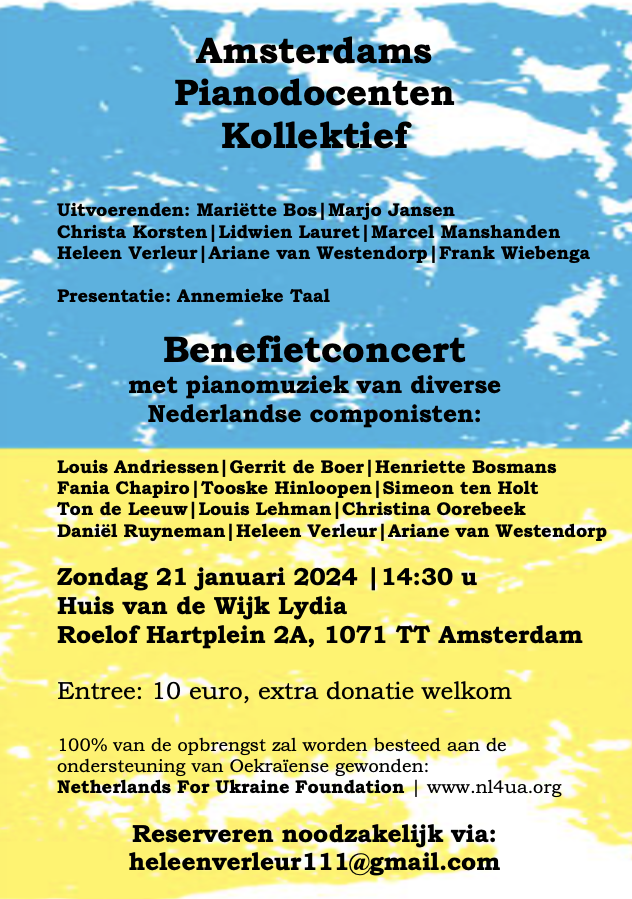
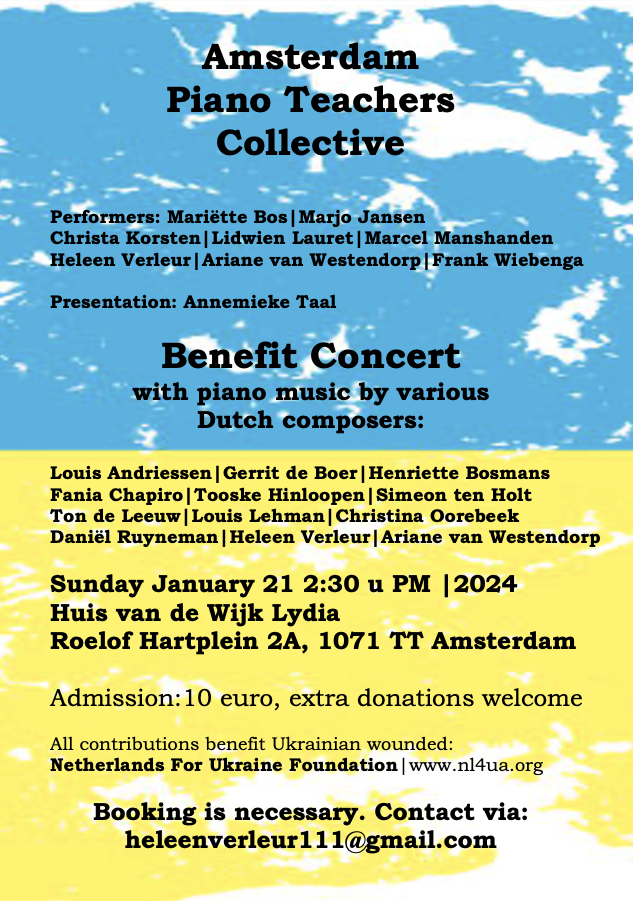
On January 21 2024, a benefit concert for Ukraine took place by the Amsterdam Piano Teachers Kollektief. It was sold out soon, but APK is planning a second concert later in the year.
Op zondag 21 januari 2024 vond er een benefietconcert voor Oekraïne plaats door het Amsterdams Pianodocenten Kollektief. Het was al snel uitverkocht, maar APK is bezig met de planning van een tweede concert later in het jaar.
Opname ‘Plyve Kacha’ | Het eendje zwemt